
August 2026 · ~7 min
Vision AI Explained: How Enterprises Are Using Visual Intelligence in Production
Vision AI has crossed from experimentation into operations - running in factories, warehouses, hospitals, and retail environments as a core part of how businesses function.

For most of its early history, computer vision lived in research labs and controlled pilot environments. The technology was promising, the use cases were clear, but production deployment at enterprise scale remained a challenge for most organizations.
In 2026, that has changed. Vision AI has crossed from experimentation into operations — running in factories, warehouses, hospitals, and retail environments as a core part of how businesses function. The global computer vision market is projected to reach USD 24 billion in 2026, growing toward USD 72 billion by 2034 at a 14.8% compound annual rate.
This is not a technology waiting to prove itself. It is a technology that enterprises are deploying, scaling, and building critical operations around.
What Vision AI Actually Does
Vision AI — also referred to as computer vision — is the capability that allows machines to interpret and act on visual information. Cameras, sensors, and imaging systems capture visual data. AI models analyze that data in real time, identifying patterns, objects, conditions, and anomalies that would otherwise require human observation.
The range of what vision AI can detect and interpret has expanded significantly. Modern systems can identify microscopic defects on production lines, analyze medical imaging for diagnostic support, track inventory across large warehouse environments, monitor infrastructure for maintenance signals, and understand spatial context across dynamic environments.
What makes 2026 different from earlier periods is not just the capability of the models — it is the maturity of the deployment infrastructure. Edge computing, improved model efficiency, and better tooling for data management have made it practical to run vision AI in real operational environments, not just on curated test datasets.
Manufacturing: Quality and Process Intelligence
Manufacturing accounts for 35.1% of enterprise computer vision spending — the largest single vertical — and for good reason. The ROI case is direct: automated visual inspection reduces defect rates, catches quality issues earlier in the production process, and reduces the cost of rework and waste.
Modern quality inspection systems use high-resolution cameras combined with deep learning models to detect defects in real time — including micro-cracks, surface anomalies, and assembly errors that are difficult to catch consistently through manual inspection alone. In 2026, 68% of manufacturing computer vision projects are focused on closed-loop defect reduction — meaning the system not only detects the issue but feeds that signal back into the production process.
Beyond quality control, vision AI is being applied to predictive maintenance — monitoring machinery continuously for early signs of wear, tracking visual patterns over time, and generating maintenance alerts before failures occur. Vision-guided robotics is another area of growing deployment: robots equipped with 3D spatial vision can navigate dynamic environments, work alongside humans safely, and adapt their behavior based on what they observe.
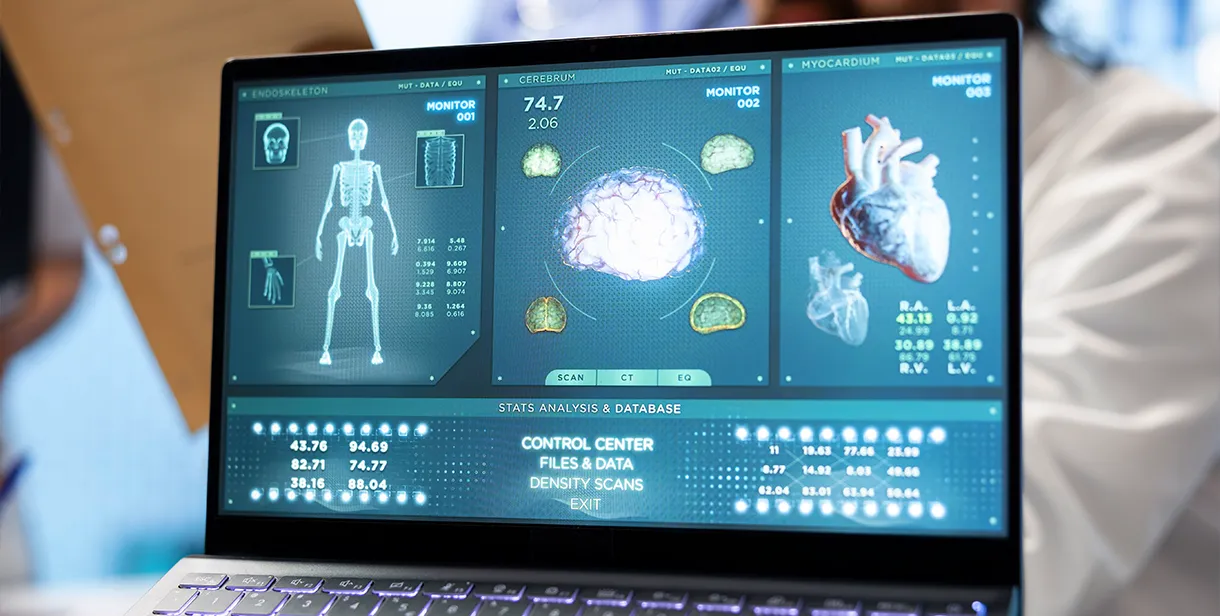
Healthcare: Diagnostic Support and Clinical Workflow
Healthcare accounts for 27.3% of enterprise computer vision spending, and the applications are among the highest stakes in any industry. 66% of healthcare computer vision projects in 2026 are imaging and diagnostics related — supporting clinical decision-making rather than replacing it.
AI-supported medical imaging has demonstrated measurable impact in clinical settings. A large-scale study found AI-supported mammography raised breast cancer detection rates by 17.6%. Stroke care platforms using computer vision have helped hospitals double their intervention rates for certain procedures.
The approach across healthcare deployments is consistent: vision AI operates as a decision-support layer. Clinicians retain full authority over diagnosis and treatment decisions. The AI surfaces information, flags findings, and accelerates the review process — reducing the cognitive load on clinical staff without removing human judgment from the critical path.
Retail, Logistics, and Infrastructure
In retail, vision AI tracks stock levels in real time, compares shelf layouts against planograms, and flags discrepancies before they affect availability. Cashierless checkout systems, which track what customers take from shelves and bill automatically, are one of the more visible consumer-facing deployments of visual intelligence.
In logistics and warehousing, vision AI supports inventory tracking, material movement monitoring, and automated stock counting. In energy, 32% of computer vision projects in 2026 are focused on infrastructure inspection — monitoring pipelines, transmission lines, and turbines for early signs of degradation, often combined with drone and sensor systems to inspect assets at scale continuously.
Edge vs Cloud: Where Visual Intelligence Runs
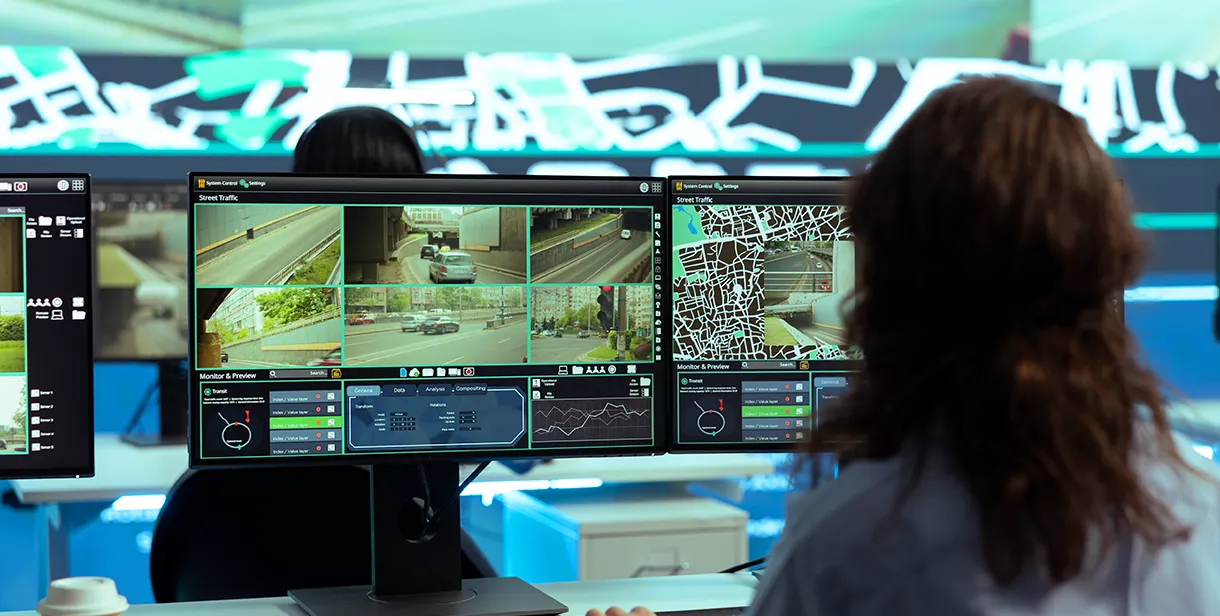
One of the most important architectural decisions in vision AI deployment is where the model runs — on a central cloud server, or on local edge hardware at the point of capture.
Cloud-based processing offers flexibility and scalability, and works well where latency is not critical. Edge deployment runs the model directly on local hardware — a smart camera, an on-device processor, or an edge computing unit — and delivers near-zero latency decision-making. For real-time quality inspection on a fast-moving production line, or safety monitoring in a dynamic environment, edge deployment is often the right choice. Many enterprise deployments combine both — running time-sensitive inference at the edge and using cloud infrastructure for model training, updates, and broader analytics.
What Production Deployment Requires
The gap between a working vision AI prototype and a production-grade system is significant. Production vision AI systems require clean, well-structured training data that reflects the real conditions the model will encounter. They require ongoing monitoring and retraining as operating conditions change. They require governance frameworks — particularly in regulated industries — that document model lineage, audit decision trails, and ensure explainability where required.
The EU AI Act, which classifies many industrial computer vision systems as high-risk, now requires enterprises operating in regulated environments to build annotation provenance, model lineage tracking, and bias auditing into their computer vision pipelines — shaping how European enterprises approach deployment architecture, and influencing practices globally.
Organizations that treat vision AI as a one-time model deployment tend to encounter maintenance challenges over time. Those that design it as an operational system — with data pipelines, monitoring, retraining schedules, and governance built in from the start — are the ones seeing consistent long-term performance.
How Misrai Builds Vision AI Systems
At Misrai, our Vision AI Platform is designed for production deployment — not demonstration environments.
We build vision AI systems around the specific operational context of each deployment: the physical environment, the latency requirements, the data infrastructure, the regulatory considerations, and the integration points with existing systems. Whether the right architecture is edge, cloud, or hybrid, we design for the conditions the system will actually run in — not idealized test scenarios.
If your organization is evaluating vision AI for a specific operational challenge — or looking to move an existing pilot into production — we build the systems that make that transition work reliably.
Misrai is a full-stack AI systems company building intelligent, deployable, and scalable AI for enterprises, government, and high-stakes industries.
Want a system built the same way?
Talk to us