
August 2026 · ~5 min
Apple Neural Engine and Qualcomm AI Stack Drive On-Device AI Adoption Across 2 Billion Devices
The on-device AI market has reached USD 33.21 billion in 2026. 97% of U.S. CIOs now prioritize edge AI, as Apple's Neural Engine and Qualcomm's Snapdragon stack power the majority of AI-capable mobile devices.
On-device AI has moved from a hardware marketing term to a production architectural standard in 2026. The global on-device AI market has reached USD 33.21 billion this year, growing at a 24.8% compound annual rate toward USD 156.59 billion by 2033. 97% of U.S. CIOs now prioritize edge AI, while 90% of enterprises have increased their edge AI budgets by 30% this year.
At the center of this shift are two silicon ecosystems — Apple's Neural Engine and Qualcomm's Snapdragon AI stack — that together power the majority of AI-capable mobile devices deployed globally.
The Architecture Divide: Integration vs. Raw Performance
Apple's A19 Neural Engine, powering the iPhone 17, delivers 38 TOPS of AI performance. Qualcomm's Snapdragon 8 Elite Gen 5 claims 100 TOPS. On paper, the gap is significant — in practice, independent benchmarks show the iPhone 17 achieving approximately 52 tokens per second in large language model inference, against roughly 10.4 tokens per second on the Pixel 10. The advantage reflects the value of vertical integration over raw TOPS figures: Apple controls the silicon, the driver, the framework, the OS, and the model weights as one coherent stack.
Qualcomm's approach is built around breadth and openness. The Snapdragon AI stack powers devices across hundreds of Android OEM configurations, from flagship to mid-range, and supports a wider range of developer frameworks. Both architectures serve real needs — the choice between them is a deployment context decision, not a quality judgment.
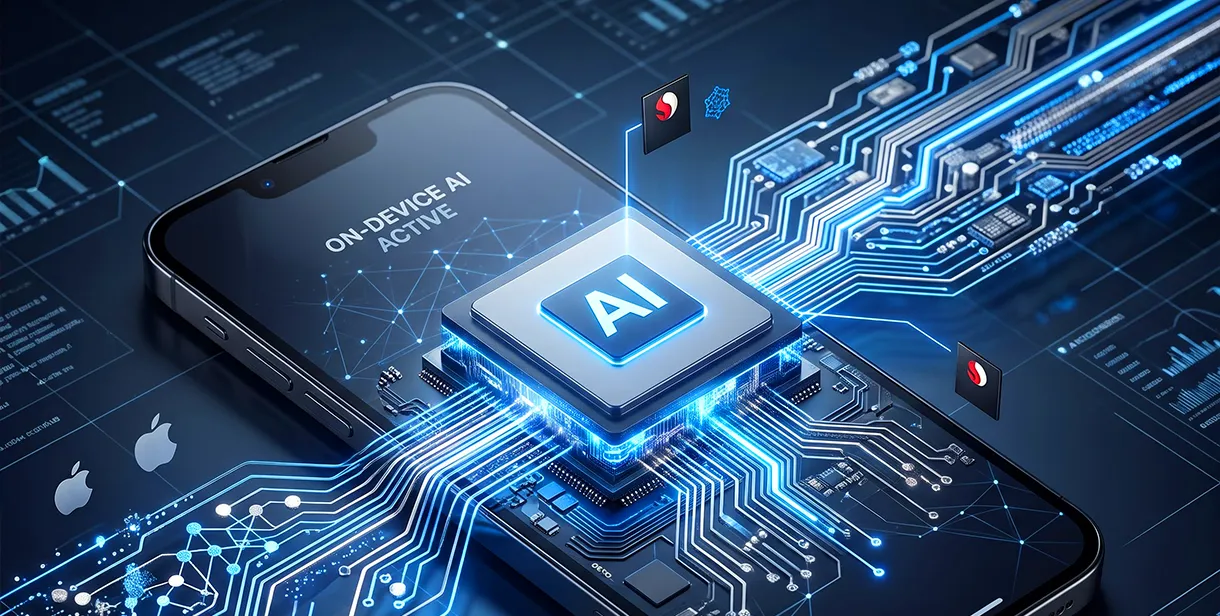
Two Approaches, One Direction
Apple's 2026 AI architecture, unveiled at WWDC 2026, presents developers with four layers: Foundation Models for on-device reasoning, Core AI for generative AI, Core ML for task-specific inference, and App Intents for Siri and Spotlight integration. Approximately 80% of Apple Intelligence requests are handled entirely on-device; the remaining 20% route to Apple's Private Cloud Compute, where user data is not retained or accessible to Apple engineers.
Qualcomm's Snapdragon 8 Elite Gen 5 delivers 100 TOPS of NPU performance — the highest published figure among current mobile chipsets — and underpins Qualcomm's push into AI PCs, automotive systems, and IoT. Microsoft's Copilot+ PC certification program, requiring a minimum of 40 TOPS of on-device NPU performance, has accelerated Snapdragon's penetration into the Windows PC ecosystem, extending on-device AI beyond mobile into enterprise computing.
Why On-Device AI Is Becoming an Enterprise Architecture Decision
The growth of on-device AI in 2026 is being driven by three enterprise-grade requirements that cloud-based AI processing does not satisfy equally well. Latency is the first — real-time applications like production-line quality inspection cannot tolerate cloud round-trip time. Privacy and data sovereignty is the second: 91% of companies believe local data processing gives a competitive advantage, and regulations like the EU AI Act and India's DPDP Act are pushing enterprises to process sensitive data at the point of origin. Connectivity independence is the third — applications that must function without reliable internet require inference to run locally.

Smartphones account for 46.2% of the on-device AI market in 2026. Beyond mobile, 85% of premium smart home devices now include AI integration, 60% of edge gateways are equipped with AI features, and industrial IoT deployments are using on-device AI for predictive maintenance that reduces downtime by up to 40%. TensorFlow Lite and PyTorch Mobile enable optimized on-device inference with models under 10MB, lowering the barrier for teams looking to ship capable AI features directly on-device.
Misrai's On-Device AI Platform is built for teams deploying intelligent capabilities directly on device - without cloud dependency, with full data privacy, and optimized for the specific silicon each deployment target requires.
Want to talk about your own AI infrastructure?
Talk to us